Metabolic Health, Healthy Ageing, Healthspan Science: The Operational Seam Where AI Belongs in a Longevity Clinic
A longevity clinic runs three sciences at once — metabolic health, healthy ageing, and healthspan research. The member does not experience three sciences. They experience one relationship with one clinic. AI's defensible place in that clinic is operational: it holds the three coherent for the member between visits, and it leaves the medicine alone.
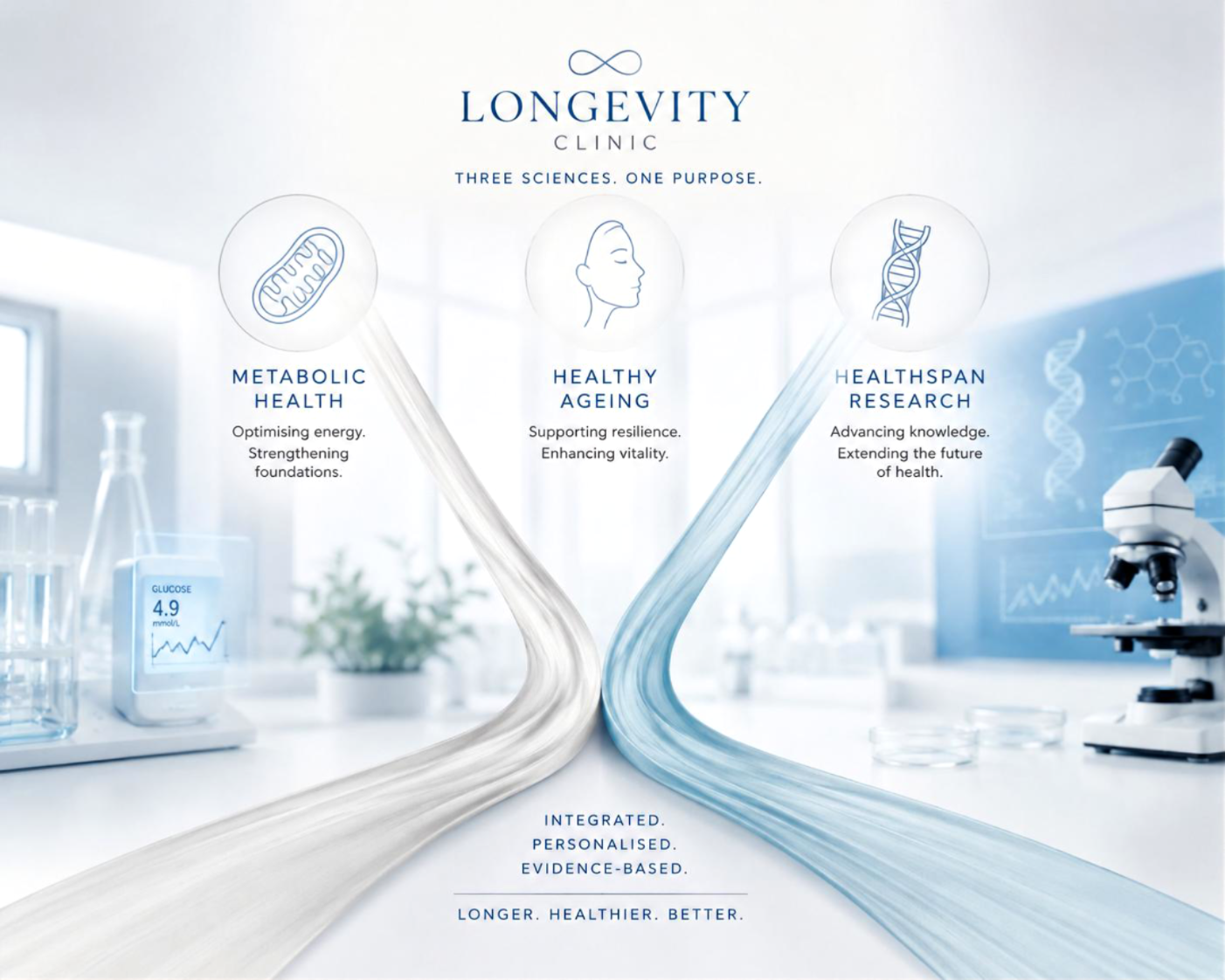
A longevity Clinic runs three sciences at once — Metabolic health, Healthy ageing, and Healthspan research.
The member does not experience three sciences. They experience one relationship with one clinic.
AI's defensible place in that the Clinic is operational: it holds the three coherent for the member between visits,
and it leaves the medicine alone.
Key takeaways
- A high level of longevity rests on three tracks — living and metabolic health, healthy ageing, healthspan science. Inside the clinic these are departments. To the member they are a single, continuous experience.
- The hardest part of merging them is operational, not scientific. A clinic can hold all three at a high standard and still deliver them as three disconnected experiences.
- AI's defensible role in a longevity clinic is the operational layer: continuity, communication, education sequencing, and the record that lets a member see one journey rather than three appointments.
- This is a marketing and operations question, separate from clinical AI. AICognitech works only on the operational and marketing layer around the medicine.
Clinics asking whether their three sciences read as one relationship to the member begin
with the AI Audit.
Why does the member feel a fragmentation the clinic cannot see?
For the clinic CEO or COO, the convergence raises a different question than it raises for the researcher. A member of a longevity clinic does not book metabolic health on a Tuesday and healthspan science in the autumn. They arrive once, as one person, and they expect the clinic to behave as one practice across the year.
What they often meet instead is three practices wearing one name. The metabolic programme lives in one app.
The ageing review arrives by email weeks later.
The healthspan reading the advisor mentioned in the room is never actually sent.
The member holds three sets of instructions, three follow-up rhythms, three points of contact, and quietly assembles the coherence themselves — or does not, and drifts.
The clinic sees three well-run departments. The member sees their own week. The gap between those two views is where retention is won or lost, and it is invisible from inside the org chart.
A concrete version: a member completes a metabolic intake in March, has an ageing-markers review in June, and hears in passing about emerging healthspan research in September. Three departments, three competent encounters. Nobody owns the line between them. The member who connects the three into a sense of progress does so on their own initiative. The member who does not is not lost to poor medicine, but to an unkept thread.
Where does AI belong in a longevity clinic — and where must it stay out?
The useful distinction is not between AI and no AI. It is between the medicine and the layer around it.
The medicine - diagnosis, the interpretation of biomarkers, the design of a protocol - belongs to the clinicians, and it must stay there. That is the clinic's licence, its liability, and its reason to exist. AICognitech does not touch it, and a clinic should be wary of anyone who offers to.
The layer around the medicine is a different matter.
The onboarding sequence that prepares a new member before they arrive.
The continuity record that lets a member, an advisor and a front desk all see the same journey.
The education delivered in sequence over the year rather than handed over in a single overwhelming intake.
The communication that carries one clinic voice instead of three departmental ones.
The retention rhythm that notices when a member has gone quiet. None of this is medicine.
All of it is where the three sciences either merge into one relationship or do not.
"This layer is where operational AI earns its place. It is the connective tissue, not the brain"
How does a clinic tell operational AI from a feature it does not need?
The market will offer a longevity clinic a great deal of software, and most of it deepens the problem it claims to solve.
Every new tool that arrives with its own login, its own dashboard and its own notification stream adds another seam the member has to feel.
There is a single test that sorts the useful from the decorative.
Does the tool make the three sciences more legible as one relationship to the member sekeeping.
A continuity layer that lets a member open one place and see metabolic, ageing and healthspan threads as one story is operational longevity infrastructure. The first is a cost. The second is the offer.
FAQ
What is meant by a "high level of longevity"?
It is the convergence of three fields a longevity clinic already works across: living and metabolic health, healthy ageing, and healthspan science. The point is not that these are new, but that the member experiences them as one relationship rather than three separate services.
Is this about clinical AI or diagnostic AI?
No. The argument is strictly about the operational and marketing layer around the medicine — continuity, communication, education sequencing, member experience. Diagnosis, biomarker interpretation and protocol design stay with clinicians. AICognitech does not work on clinical AI.
Why is merging the three pillars an operational problem rather than a scientific one?
The science of integrating metabolic, ageing and healthspan work is advancing on its own. The barrier the member feels is that the three reach them through separate apps, voices and follow-up rhythms. That fragmentation lives in operations, not in the lab.
Where does operational AI add value in a longevity clinic?
In the layer between visits: pre-arrival onboarding, a shared continuity record, education delivered in sequence, member communication in one clinic voice, and retention rhythms that notice disengagement early.
How can a clinic tell useful AI from another tool it does not need?
Apply one test. Does it make the three sciences more legible as a single relationship to the member, or does it only make one department more efficient in isolation? The first is operational longevity infrastructure. The second is housekeeping with a login.
Introduce Clarity, not Complexity.
An AI Audit from AICognitech helps you identify where AI can genuinely serve your clinic's mission—before you invest in tools, teams, or timelines.
→ cebuan@aicognitech.com
#LongevityClinics#LongevityMedicine#PrecisionMedicine#ConciergeMedicine#Healthspan

Copyright 2025 AiCogniTech | All Rights Reserved